 North Korea Increases Aid to Russia, Mos... Tue Nov 19, 2024 12:29 | Marko Marjanovi? North Korea Increases Aid to Russia, Mos... Tue Nov 19, 2024 12:29 | Marko Marjanovi?
Trump Assembles a War Cabinet Sat Nov 16, 2024 10:29 | Marko Marjanovi?
Slavgrinder Ramps Up Into Overdrive Tue Nov 12, 2024 10:29 | Marko Marjanovi?
?Existential? Culling to Continue on Com... Mon Nov 11, 2024 10:28 | Marko Marjanovi?
US to Deploy Military Contractors to Ukr... Sun Nov 10, 2024 02:37 | Field Empty Anti-Empire >>
Indymedia Ireland is a volunteer-run non-commercial open publishing website for local and international news, opinion & analysis, press releases and events. Its main objective is to enable the public to participate in reporting and analysis of the news and other important events and aspects of our daily lives and thereby give a voice to people.
Trump hosts former head of Syrian Al-Qaeda Al-Jolani to the White House Tue Nov 11, 2025 22:01 | imc
Rip The Chicken Tree - 1800s - 2025 Tue Nov 04, 2025 03:40 | Mark
Study of 1.7 Million Children: Heart Damage Only Found in Covid-Vaxxed Kids Sat Nov 01, 2025 00:44 | imc
The Golden Haro Fri Oct 31, 2025 12:39 | Paul Ryan
Top Scientists Confirm Covid Shots Cause Heart Attacks in Children Sun Oct 05, 2025 21:31 | imc Human Rights in Ireland >>
Super Flu? More Like Super Hype Sun Dec 14, 2025 13:05 | Dr David Livermore
Present case numbers for the ?K? variant Super-Flu don't justify the hype, says Dr David Livermore. Perhaps it's the media lust for fear porn, or perhaps the Government's fear of the strike, but it's not a Super-crisis.
The post Super Flu? More Like Super Hype appeared first on The Daily Sceptic.
Ten Dead in Bondi Beach Terror Attack Sun Dec 14, 2025 11:05 | Jonathan Barr
At least ten people, including children, are dead after gunmen opened fire during a Hanukkah party on Bondi Beach in Sydney.
The post Ten Dead in Bondi Beach Terror Attack appeared first on The Daily Sceptic.
Beano Brain: Why Does the Beano Have its Own Special In-House Child Psychology Unit? Sun Dec 14, 2025 09:00 | Steven Tucker
In the good old days, children's comics had one purpose: to be funny. Now, the Beano sees its mission as 'mental health' ? and has its own in-house child psychology unit to keep it on message, says Steven Tucker.
The post Beano Brain: Why Does the Beano Have its Own Special In-House Child Psychology Unit? appeared first on The Daily Sceptic.
America?s New Security Doctrine and the Reordering of Global Energy Geopolitics Sun Dec 14, 2025 07:00 | Tilak Doshi
Washington's newly released National Security Strategy has struck Europe with the force of a long-suppressed truth bluntly delivered ? and energy geopolitics is at the heart of the seismic shift, says Tilak Doshi.
The post America’s New Security Doctrine and the Reordering of Global Energy Geopolitics appeared first on The Daily Sceptic.
News Round-Up Sun Dec 14, 2025 00:45 | Will Jones
A summary of the most interesting stories in the past 24 hours that challenge the prevailing orthodoxy about the ?climate emergency?, public health ?crises? and the supposed moral defects of Western civilisation.
The post News Round-Up appeared first on The Daily Sceptic. Lockdown Skeptics >>
Voltaire, international edition
Will intergovernmental institutions withstand the end of the "American Empire"?,... Sat Apr 05, 2025 07:15 | en
Voltaire, International Newsletter N?127 Sat Apr 05, 2025 06:38 | en
Disintegration of Western democracy begins in France Sat Apr 05, 2025 06:00 | en
Voltaire, International Newsletter N?126 Fri Mar 28, 2025 11:39 | en
The International Conference on Combating Anti-Semitism by Amichai Chikli and Na... Fri Mar 28, 2025 11:31 | en Voltaire Network >>
|
Review: Caliban and the Witch
 international |
gender and sexuality |
opinion/analysis international |
gender and sexuality |
opinion/analysis
 Tuesday September 12, 2006 14:54 Tuesday September 12, 2006 14:54 by Tobie - WSM by Tobie - WSM

women, the body and primitive accumulation
Silvia Federici’s “Caliban and the Witch; Women, The Body and Primitive Accumulation” does a fantastic job of taking the feminist analysis of the body and re-conceptualizing it within a class struggle understanding of history. She fills in the blanks that a traditional left analysis has missed, including the concepts of difference, women, race and the body. This work is very important, allowing feminists and socialists alike to realize that identity and class struggle are not polar opposite theoretical understandings
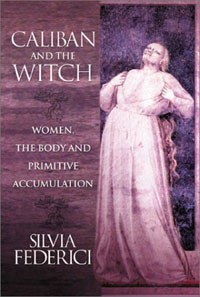 Cover of Book Federici’s background comes from Italian Autonomous Marxism, from her comrades in the Midnight Notes Collective on the US East Coast, and past influences including Maria Rosa Della Costa - author of “The power of Women and the Subversion of the Community” (1971) and Selma James author of “Sex, Race and Class” (1971). She was in the wages for housework movement that discussed how capital was dependent on domestic labour and developed the understanding that patriarchy worked alongside capitalism to enslave women. She also spent time in Nigeria working on issues of development and feminism which resulted in her writing many works on globalization, structural adjustment and the IMF. These experiences put her in a good position to have an insight on a society that was forced to move from communal living to that of capitalism. This book is her project to express an understanding of women’s position in our society and the effects of globalisation and imperialism.
Feminists have always critiqued Marxist theory for not acknowledging the reproductive role of women and the importance of the body in production. Feminists have taken time to show how the body is a place of struggle and resistance. Federici continues to do this without disregarding class struggle as fundamental. Instead she gives an argument for how the body and female sexuality, reproduction and knowledge have been systematically targeted in order to break solidarity of working class struggle. She gives examples of its use in destroying the rebellious serfs: “efforts were made by the political authorities to co-opt the youngest and most rebellious male workers, by mean of a vicious sexual politics that gave them access to free sex, and turned class antagonism into an antagonism against proletarian women” (pg. 47) As anarchists this is very important, realizing the feminism is not individualist but involved in complex power structures.
The book jumps back and forth in both time and place so the reader should either have good knowledge of feudalism or get ready to be a bit confused. It goes from looking at the serfs’ struggle for land and the heretical use of religion to challenge hierarchies and power, then moves onto the colonization of the Americas and demonisation of aboriginal cultures. The main argument focuses on the witch trials as the central example of how women’s bodies were targeted in a counter-revolutionary strategy to facilitate primitive accumulation, i.e. the historical process of divorcing the producer from the means of production.
The period which saw the transformation from feudalism to capitalism involved what Marx termed primitive accumulation. In Europe this saw the working population (serfs) of Europe being deprived of the ‘means of production’ e.g. land. Primitive accumulation also involved the enslavement of some of the population of Africa and the America’s and the use of this enslaved labour to extract gold and silver from the new world. All together this primitive accumulation created both the capital and dispossessed workforce on which capitalism was built.
One of Federici’s main arguments is that the transformation to capitalism of primitive accumulation was not just the economic relationship to labour and production but also includes reproduction and the alienation from the body through science and wage work.
In Federici’s overview of the serfs’ struggle and the heretical movement in the first part of her book, she says that it was their struggle and the failure of feudalism that brought along capitalism. She included the importance of women’s role during this time, where women were less dependent on men economically and socially and where they treated on more equal basis. This is not to say that there was any form of feminist utopia. Saying both that this was the first women’s movement in several European countries as well as the first proletariat international.
Unlike the American witch trials the European ones included both men and women. Silvia concentrates on the prevalence of women being targeted. She importantly genders and classed the witch trials by looking at who was being prosecuted and why. The witch trials were an exemplary performance used to discipline other unruly subjects through example. It is interesting to note that neither men nor women stood up to stop or challenge the witch trails and subsequent burnings.
She places the witch trials into a historical context to understand why women were being prosecuted. Two things happened in this time. First of all, the banned certain ways of life and secondly science and intellectualism provided a way of understanding the world that legitimised this change. It was a change of culture from a time of living on commons and communal living to a time of capitalism and the individual. Those affected most by this change were elderly women who no longer were taken care of through the “moral economy” and had to steal from private land to survive. It was these women who were being persecuted as witches. Secondly there was the introduction of science, the redefinition of the body and the interest in anatomy which changed the body to a machine that can be modelled into a worker.
Women’s knowledge was destroyed by the transition into capitalism. Women’s knowledge whether it was midwifery or medicine was demonized since it didn’t work within the confines of science and intellectualism. This intimate knowledge of the body was passed on over generations through oral tradition. So the process of alienation from production occurred alongside an alienation from reproduction. The witch trials were a hunt to erase any form of control over the women’s body such as knowledge of birth control, abortion, midwives and medicine women. She argues that the witch trails in Europe and the Americas have a very similar root; anyone who was using other forms of knowledge and understanding that challenged the capitalist, imperialist goal was targeted either as a witch or a savage.
This understanding of women’s work gives insight to the root of what is called the feminization of poverty. This is the fact that the majority of the world’s poor are women. According to the UN, even today women earn about half of what men earn.
The book itself, although full of insightful and captivating ideas, is plagued with an academic language and style. Those interested in engaging with her work will find her examples and theoretical analysis very interesting. For those who would rather learn in other ways, I encourage you to listen to her talk on the book at Fusion Arts in New York City on November 30, 2004 which is hosted on Interactivist Exchange. She gives a detailed overview of her thesis and the reasons she finds her work important now.
|





 printable version


 Digg this
 del.icio.us
 Furl
Furl Reddit
 Technorati
 Facebook
 Gab
Gab Twitter
View Comments Titles Only
save preference
Comments (1 of 1)
Jump To Comment: 1The book jumps back and forth in both time and place
Is the ancient world covered at all or does her analysis start with feudalism? Also, what were the reasons for persecuting men as witches? Nicely written review. Thanks.